In this unit, we learned about evolution and its related processes and patterns. Evolution is a theory supported by numerous sources of evidence, such as analogous structures, where different species develop the same structures in different ways due to its benefits; developmental evidence, which can show processes shared in common by related species; homologous structures, which can show structures that have been adapted differently by diverging species; and fossils, which form a fossil record that can be used to track evolution across time. Evolution is mostly dependent on natural selection, though it is also affected by genetic drift, random changes in the population; gene flow, the movement of alleles; mutations, which influence and are acted on by natural selection; and sexual selection, a similar process involving selection for traits advantageous for mating success.
Result of artificial selection in carrots
Like artificial selection, a process involving breeding a population for certain traits favored by humans, natural selection is a change in allele frequency in a population over generations. It occurs due to survival benefits certain traits give individuals. In addition, though the gene pool changes continuously over time due to natural selection, lethal alleles can remain as recessive alleles that may be influential in the event of changing conditions.
As the population changes, patterns such as stabilizing selection, directional selection, and disruptive selections can appear. These relate to how different phenotypes become more less common, favoring an extreme, the intermediate, or both extremes. Disruptive selection is also a cause of speciation. Speciation occurs as new species rise due to behavioral, geographical, or temporal isolation. This can occur continuously, through gradualism, or in uneven stretches, as in punctuated equilibrium.
Allele frequency change over time in Hunger Games lab
In a nutshell, this unit has been a whirlwind of ideas that tie in old concepts and new ones alike. (e.g. genetics, inheritance, populations) It has given many answers, though questions do not equally abound. For example, the information about homologous structures and fossils provoked questions about how these fossils actually change, and what genes control them. Partaking in the Hunger Games lab was particularly interesting, as it demonstrated real-time (or sped-up time really) how different factors play into the change in a population. Even the unexpected outcome still showed how genetic drift and new behaviors can affect what happens.Additionally, the vodcast on the history of life makes one wonder what exactly occurred that changed things so much. (go to my 20 time project to learn more!)
In the last unit reflection, I made it a goal to more assertive, after exploring some of the different conflict styles. (e.g. passive, aggressive, assertive) Since then, I have put some effort into that goal, trying to put out a clearer opinion during group projects and, to some extent, in my life. For example, during a PE project, I made sure to maintain my priorities and to ensure we finished on time by keeping the group on schedule. I will continue to work toward this goal in the coming weeks, and I hope to be successful.
All in all, I am looking forward to the next unit, and learning more about......kingdoms and phyla? That proves to be an adventure, and we shall see what it holds.
In this lab, we simulated real-life natural selection patterns through an experiment involving picking up food (corks) in various ways based on three different phenotypes: stumpies (AA), knucklers (Aa), and pinchers (aa).
Lab overview and procedure
Knucklers and pinchers were the best at catching food, as knuckles or fingers were better for picking up food, and thus survived the most. The small a allele increasing significantly in frequency supported this, going from 50% of the gene pool to 0.74% of the gene pool in round 5.
In our experiment, our population evolved, as the allele frequencies shifted significantly due to differences in individual phenotypes. The frequencies of the large A and small a alleles went from 0.5 and 0.5 to 0.38 and 0.62 over the course of the experiment. In addition, at the end of the experiment, there were 14 knucklers, 6 pinchers, and 1 stumpy from the 10-10-10 makeup of the beginning; all of the data points to a gradual shift in the gene pool of the population.
Graph of allele frequency over time in experiment
Much of the changes in this experiment were due to non-random factors (e.g. natural selection). However, random events also impacted the experiment; genetic drift caused by changes in the food dispersion, as well as cheating to survive both affected the data. When the food was gathered in piles near some individuals, they were able to collect more food and thus survive and reproduce better. Additionally, some individuals resorted to cheating (i.e. grabbing technique) when selective pressures were high, and thus had an advantage unrelated to their traits.
In nature, when resources and conditions change, individuals and populations are affected: adaptations come into effect, and some individuals die out as a result of being unfit for the new conditions. For example, if an invasive species were to be introduced into the area, it might kill off or compete with the population, thus causing fewer individuals to survive. Similarly, the results of the lab may have been different if some key factors were changed. If the food was larger, the stumpies may have fared better, with an easier time picking up the food. On the other hand, if the food was smaller, it might benefit the pinchers, as they have an advantage picking up smaller food over the other phenotypes.
If there were not incomplete dominance, then there would be many more stumpies (making up 75% of the potential genotypes from a double heterozygous cross), as they are a result of the dominant big A allele. Conversely, without the knuckler phenotype, the pinchers would quickly outcompete the stumpies and dominate the population.
In this lab, we saw how natural selection is a major driving force of evolution, as it changes populations to make traits beneficial for survival more common over generations. Our beneficial allele was the small a allele, as pinchers and knucklers were better at surviving, so over time that allele became increasingly prevalent. Therefore, there were more pinchers and knucklers at the end.
Individuals adopted new techniques during the experiment. When selective pressures were high, they often cheated with a grabbing technique to increase their chances of survival. This likely led to there being more individuals with inferior phenotypes (i.e. more stumpies survived). Thus, it would have also increased the frequency of large A alleles. In nature, adaptations over time would play a similar role, beneficial mutations leading some to survive while others died off. An example would be the peppered moth: the black phenotype let the moth better camouflage from predators during the Industrial Revolution, and thus individuals with that phenotype had an advantage.
Natural selection acts on populations over many generations, and occurs due to beneficial traits of individuals. This can be seen in this lab: the beneficial traits that pinchers and knucklers had to pick up food caused their genes to be passed on more often (survived more often), and thus the population's gene pool was affected.
This unit was a tour in the essential "study of house," a branch of biology that grows in importance every day due to the numerous causes of damage to the environment. Ecology can be studied on many levels, from the smallest niches, full of factors and adaptations species need to survive; to complex food webs, structures linking hundreds or even thousands of producers and consumers of every trophic level, transferring less and less energy until apex predators get close to none; to entire ecosystems, rich with different organisms and the abiotic factors that affect their lives, as well as cycles of the nutrients they need; to the biosphere itself, extending worldwide and encompassing all life on earth.
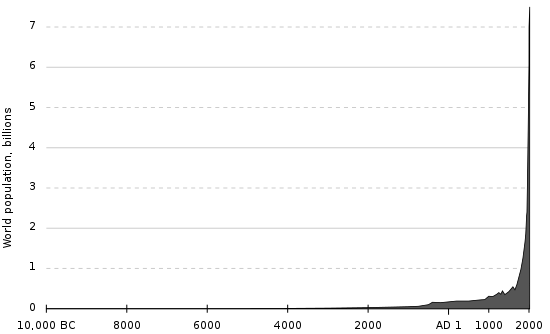
Human population growth diagram
Likely the most directly linked topic to humans is human population, which, like populations of any animal, is affected by factors such as immigration, disease, density, and dispersion. Like any population in its initial stages, the human population is also growing exponentially, though the carrying capacity of the earth can only support about 10-15 billion in total.
One of the largest concerns currently is humans' effect on the planet. Through climate change, overexploitation, and introduced species, and habitat loss, we have created the sixth mass extinction, and have endangered a large percentage of all species. Unless we work as individuals and a society to conserve and restore resources and save biodiversity, the world as we know it will surcease.
Ball-and-stick model for polyethylene terephthalate (PET)
This unit has indeed left me with some unanswered questions, such has how exactly our harmful, as well as restorative, processes work. (e.g. power plant and engine emission chemistry, properties of plastics and recycling for different plastics) A further exploration into basic economics and manufacturing could also help me broaden my knowledge, as would knowing more about the largest threats to the environment. What are the main causes of introduced species in the modern world? What industries and specific techniques should be targeted to reduce habitat loss and overexploitation?
Much of the time we spent in this unit was working on a Conservation Biologist Project. In my group, we worked to create an effective presentation (see above) covering the environment and threats of the Ecuador cloud forests, as well as attempting to formulate solutions directed at these threats. Most of the time, we worked together well as a group, fulfilling group goals and individual tasks on schedule, and we were equally successful with our research. It was a bit difficult to coordinate large tasks as a group, such as putting together the works cited and getting the individual recordings done for editing, but in the end we were able to keep everyone, for the most part, on schedule, and wrapped up the work on time. If I were to do a similar project in the future, I would probably be more specific and break down goals. Furthermore, I would try to enforce goal deadlines better so that group members finished tasks on time without fail.
A concept we learned was the different conflict management types: assertive, passive, aggressive, and passive-aggressive. After taking a self-assessment on the topic, I determined that my leading types were assertive (35%) and passive (27%); my goal is to be more assertive, which would entail being more clear and straightforward with my ideas, as well as keeping my priorities in mind as I communicate.
In general, I look forward to learning more in the realm in biology, whatever it may be. On a side note, I will also work toward improving my writing, whether it be in biology reflections, or in any number of other applications.
This unit was one that saw the beginning of biology being tied in with real life: biotechnology is the application of biology in a wide range of fields, from gene therapy to transgenic organisms to fermentation. The different branches of biotechnology are industrial and environmental, agricultural, medical and pharmaceutical, and diagnostic research; furthermore, they involve techniques to manipulate inheritance and DNA.
Agar plate for use in DNA transformation
PCR is a fundamental procedure: a denatured template strand has primers annealed to it, and then DNA polymerase is used to extend the primers in several cycles. Soon, millions of copies of the strand of DNA can be produced. This DNA can be analyzed and sequenced through gel electrophoresis: the setup of electrodes around a gel box with different DNA samples causes shorter DNA strands to move faster through the pores of agarose gel, pulled by the backbone's negative charge. In order to test the composition of various dyes found in candy, we used this process in the gel electrophoresis lab. The test allowed us to see how the chemical structure of different dyes made them run differently in the gel, and how different dyes were sometimes mixed to produce a wider variety of colors.
Gel electrophoresis in action
In addition, fluorescent dyes can be attached to increasingly longer copies in a PCR reaction to yield a sequence of different dyes that correlate with base pairs. After gel electrophoresis, the base pairs can be analyzed, and an electropherogram can be produced. Another technique involve creating transgenic organisms using restriction enzymes and ligase. The enzyme cuts the strand at a restriction site, creating sticky ends, and the spliced piece is attached to another strand using ligase. We were exposed to the results of this technique in the pGLO lab, in which we introduced engineered plasmids into bacteria to make them produce GFP and glow in black light. A setback here was that due to imprecision at some point in our experiment (see the page for more detail), our plasmids were unable to become integrated into our bacteria, rendering the end result a failure. Nevertheless, as we witnessed the success of other groups, it showed how revolutionary this technology was, in changing the very DNA of bacteria to make it undergo different processes.
Recombinant DNA manipulation in action
However, these extensive processes allow humans to manipulate organisms and inheritance in an unprecedented, highly intrusive manner. Bioethics is a specific branch of biology dedicated to determining the ethics of using new technologies based on values and morals. The questions posed are endless, and include dilemmas such as if stem cells from embryos should be used to treat diseases, as well as if life should be extended and human capabilities enhanced.
Overall, the unit was very unique in that it expanded from the usual biological theory and introduced tangible applications of manipulating biological molecules and processes. An observation I might make about my performance in this unit, in comparison with previous ones, is that as the procedures grew more complex, I felt more detached and intimidated by all of the advanced techniques involved. However, it was truly the labs that brought me back to the reality of how it could be done easily, even with limited equipment. Rather than being lost in the causes and effects of how everything worked, I became more concerned with the actual organisms and molecules we analyzed and worked with. I believe this really is what sets this unit apart from all of the others (so far), and what at the same time tied everything together.
To check back on my goals from the new year, I would say I have improved at least somewhat in better connecting the different subjects in summaries (relate and reviews, textbook notes, reflection, etc.) and in my mind. Perhaps it is the unit topic, but I can now more coherently visualize what processes and concepts affect one another. In the coming unit(s), I will also try to follow up on my goal of finding further information on each topic to broaden my understanding; of course, I will also continue to make more connections in writing and otherwise. In general, I look forward to either returning to the comfortable world of abstract mechanisms and learning more about the natural processes on Earth (ecology perhaps?), or wandering further in this new frontier of applied technology.
In the pGLO lab, we added plasmids to E. coli bacteria containing araC, GFP, and ampicillin resistance genes. After heat shocking the bacteria, we plated them onto luria broth with ampicillin nd arabinose and waited for the colonies to grow. Though my group's bacteria failed to receive the plasmid successfully due to possible errors in adding the plasmid and heat shocking, we recorded data from a more successful group to analyze.
Our failed plates (note no GFP in bacteria seen under black light)
Another group's successful plates (from left to right: -pGLO with LB, +pGLO with LB and amp, +pGLO with LB, amp, and arabinose)
Plate
Number of Colonies
Color of colonies under room light
Color of colonies under UV light
- pGLO LB
1 large colony with incoherent boundaries
Murky gray
Yellowish gray
+ pGLO LB/amp
9 large colonies
Murky gray
Yellowish gray
+ pGLO LB/amp/ara
7 colonies
Murky gray
Bright green
There were likely about 10,000,000 bacteria in each 100 uL E. coli sample plated, assuming about 100,000,000 in each milliliter. This estimate takes into account the millions of bacteria that exist everywhere and gives a reasonable number without a reference, though an equally large number is possible as well.
Out of these, a very small number of bacteria (i.e. around 1,000,000) successfully received the plasmid. These transformed bacteria had the pGLO gene as well as ampicillin resistance, allowing them to be isolated in the luria broth, as the ampicillin killed off the rest of the bacteria. In addition, arabinose acted like a trigger to activate the GFP intron in the pGLO plasmid, allowing the bacteria to produce GFP when the sugar was present. Where arabinose was absent, (as in the +pGLO LB/amp plate) the gene was not expressed; in the plate with the trigger sugar, the gene was expressed, and the bacteria glowed.
This kind of genetic engineering is very useful and can be applied in a variety of places. GFP is used in many areas, including as a cell marker, in which it is added to plasmids of interest to gauge how many bacteria have successfully taken in the plasmid; as a transcription reporter, in order to monitor the expression under a certain promoter; and in FACS (fluorescence-activated cell sorting), to separate different cells based on their fluorescent signals. Furthermore, genetic engineering involving the enzyme Cas9 in CRISPR editing can be done in order to modify the genome of different organisms, including humans, with low costs and equipment. This can been done to change the inheritance of traits or characteristics of embryos, and is currently being studied.
Though there are natural alternatives, artificial food colors can be preferable to both consumers and manufacturers. They are much easier to mass-produce and obtain, and also include a wider range of bright colors (or colors that make food seem fresher) that can seem more appealing to consumers. Though I usually tend to avoid foods and snacks with dyes, I have seen sodas that contain different dyes, as well as chips (e.g. Doritos) that contain dyes like Yellow 5 and Yellow 6. Additionally, one large source of artificially dyed foods is dog food: manufacturers tend to add artificial food colors like Yellow 5, Blue 2, Red 40, and Yellow 6. This is likely to create a more “nutritious” appearance that may sway consumers.
In our DNA electrophoresis lab, we ran dyes found in various common candies. We used the Red 40, Yellow 5, Yellow 6, and Blue 1 reference dyes to compare our dyes to. Observing the molecular structures of other dyes, we can see that they have similar structures to the four reference dyes we used, with analogous substituents (e.g. phenyl, hydroxyl, carbonyl); these similar structures would lead to them to migrate similarly in gel electrophoresis. For example, carminic acid is similar to Yellow 6, betanin acid bears resemblance to Yellow 5, fast green FCF is like Blue 1, and citrus red 2 resembles Red 40.
Our dyes ran mostly as expected, with the orange dye being Yellow 6, and the other dyes turning out to be their corresponding reference dyes. However, our green dye separated into 2 different bands when we ran the gel electrophoresis. This green was actually a mixture of a blue and a red dye (Blue 1 and Red 40), since green dyes are likely harder to produce.
Final gel results (4 test dyes on left, 4 reference dyes on right)
The colored dye solutions we used also migrated different distances, and this effect was contributed to by multiple factors. First of all, the larger molecules are less flexible and will be hindered more by the gel’s channels. Also, the molecule concentrations would make a difference: a dye with a higher concentration might advance slower than another dye with a lower concentration.
Gel electrophoresis setup
The movement of the dyes through the gel is facilitated by their negative charge and the voltage of the electricity. Their charge makes them attracted toward the anode, and smaller molecules can advance further, because they are less obstructed by imperfections and twists in the gel. DNA molecules, which are commonly used in gel electrophoresis, would also separate like the dyes we used. DNA of a lower dalton size would advance the furthest, while the largest molecules would advance much slower and thus traverse less distance.
This semester I will strive to improve upon last semester's performance in several specific ways. In order to attain more understanding in biology, I will study and investigate more into each unit. I will make connections to different aspects of biology and find in-depth information about each one, enhancing my understanding about the specific subject and its place in the world of biology.
Additionally, I will improve my expository writing in English, which will entail forming stronger and better substantiated points and theses, as well as creating a conclusion that better wraps up the essay. This will allow me to better express my opinion and evidence in future letters or pieces of writing.
In order to gauge my progress, I will reflect (perhaps sometimes physically) on my accomplishments toward my goal in each unit or subject: in Biology, this would involve connecting the topic to other concepts, while in English I would keep track of each facet I expressed successfully or included after each essay or other practice opportunity.